
Gingerbread Week Activities for Kindergarten and First Grade
Gingerbread week gives your class a familiar character to follow from the reading rug to the math table. A cookie can become something to describe, measure, count, and write about, while a paper house gives those ideas a place to land. These gingerbread activities for kindergarten and first grade bring eight resources together, with room to choose what fits your students and your December schedule.
You do not need to complete every page or squeeze every craft into five days. Choose one shared experience each day, then use the related readers, writing pages, and centers where they fit your regular routine.
This post contains affiliate links. As an Amazon Associate I earn from qualifying purchases.
Start with a gingerbread story
Begin with The Gingerbread Man by Karen Schmidt, then add Gingerbread Baby by Jan Brett and The Gingerbread Girl by Lisa Campbell Ernst across the week. After each read-aloud, invite children to name the character, explain the problem, and describe the ending. A simple class chart helps students compare the stories without turning every read-aloud into another worksheet.
The Gingerbread Man Story printable reader gives children another chance to follow a familiar sequence. Pair it with the cookie-sheet sequencing and retelling craft, or prepare the pieces as a reusable center. Model moving one picture at a time while saying what happened first, next, and last. Color and black-and-white options and K–2 writing lines let you choose a manageable version for your group.
Turn baking into how to writing
How to Bake a Gingerbread Man connects oral language to a clear sequence of steps. Read the printable reader together, act out the process, and let partners rehearse their directions before writing. Children can use the how-to planner, word bank, and checklist to keep track of what they want to say.
Choose from the K–2 writing lines, then pair the finished directions with the oven craft. A child who is still building confidence can draw and dictate a step; another can explain each step in a sentence. You can teach the sequence without baking in the classroom. If you do bake, follow your school’s food and allergy procedures.
Make math hands on with gumdrops
Gingerbread Gumdrop Math offers plenty to choose from: sorting, tallying, graphing to 8, counting and comparing, addition and subtraction, measuring, patterns, five senses, and a gumdrop-and-toothpick house STEM activity. Select tasks that match the skills your students are practicing rather than setting out everything at once.
Start with a small collection and ask children to sort it, explain their rule, and compare groups. At another table, students can build a pattern and tell a partner what comes next. Keep graph quantities within the printed scale. For the house challenge, model safe toothpick handling and give students time to test, talk, and revise. Use supervised small groups and appropriate nonfood substitutes when needed.
Investigate one class cookie together
Gingerbread Investigations brings science into the week through five-senses observations, measuring, describing, and a class cookie water test. Invite children to look closely and share describing words before recording their ideas. Taste is optional and should follow your school’s food rules and individual dietary needs.
For the water test, use one class cookie. Students predict what will happen, watch for changes, and describe what they notice. Their own cookies stay dry for optional eating afterward. Talk about the cookie getting wet, softening, or breaking apart if those changes occur, rather than calling the investigation melting. Compare predictions with observations and remind students that an unexpected result is something to discuss, not a wrong answer.
Count shapes while creating
The Shape Gingerbread math craft gives students a reason to look carefully at their designs. As children assemble their gingerbread characters, ask them to name shapes and describe what they notice about sides or corners. Follow with the shape-counting and graphing pages so the math stays connected to the finished craft.
Model counting each shape once before students record their totals. A partner can point while the creator counts, then the pair can check the graph together.
Build a gingerbread neighborhood
With Build Your Own Gingerbread House, students can choose a 3D house or a fold-open house craft and add writing. Set out a finished example so children can see how the pieces fit, then model the trickiest fold before they begin. Choose the version that works for your available time and students’ cutting and folding skills.
Use the writing to describe a house, explain a favorite detail, or imagine who lives inside. Display the houses together as a gingerbread neighborhood. This paper craft also gives you a food-free option alongside the gumdrop house STEM challenge.
Write a plan to catch the gingerbread man
After several stories, children have plenty of ideas for How to Catch the Gingerbread Man. Ask students to draw their plan and explain it to a partner before writing. Where will the gingerbread man go? What will happen next? Could he escape?
The writing craft includes K–1 and 2–3 options. Choose the support that fits your writers, and invite children to add details that make their plan easier for a reader to picture.
Finish with a gingerbread baby adoption
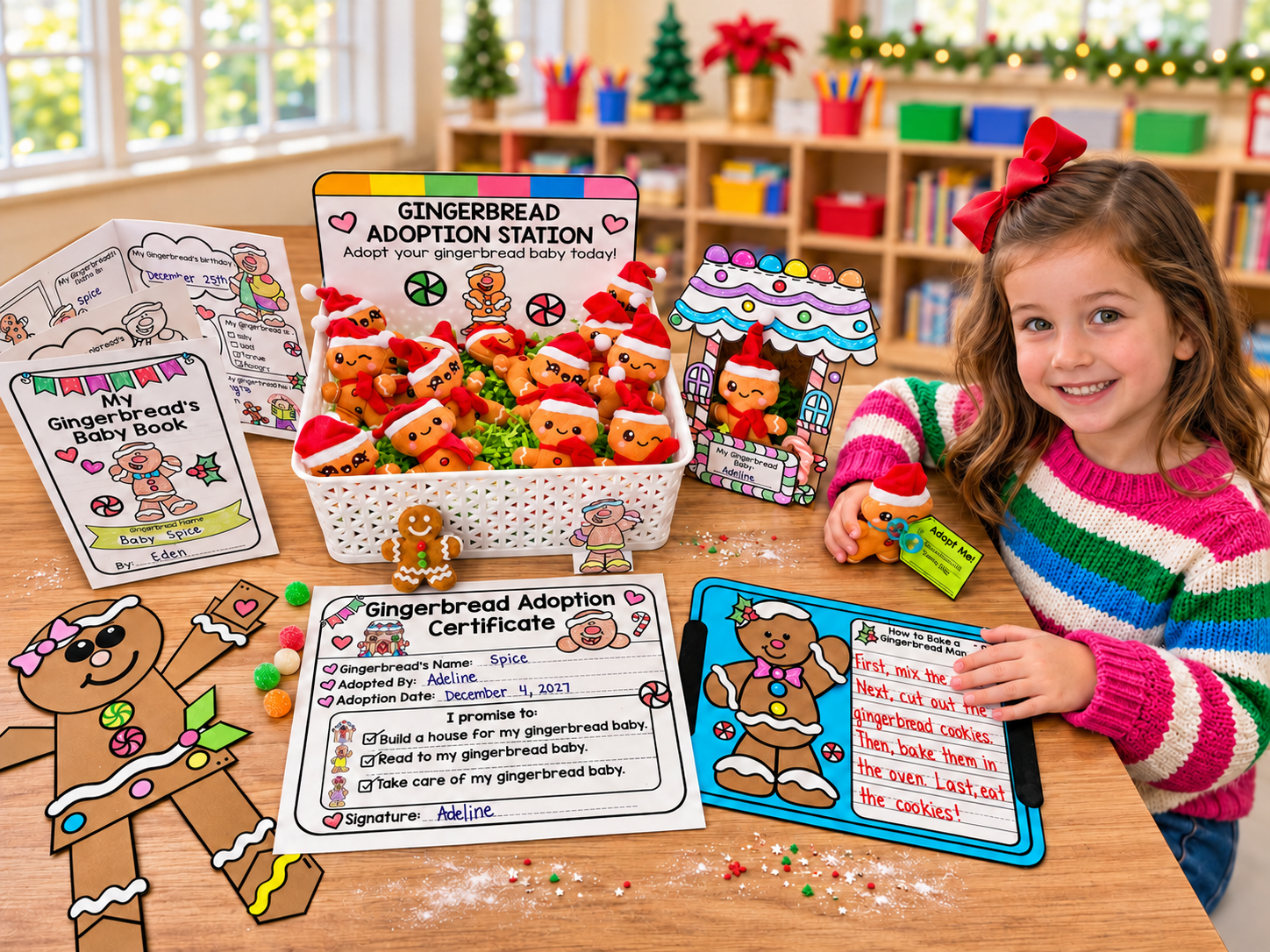
Adopt a Gingerbread Baby makes a sweet Friday writing invitation. Set up the station with the signs, then let children name a baby and complete an adoption certificate. The mini creative writing baby book gives them a place to imagine details about their new character, and the paper bag house becomes its home.
Printable paper babies keep the activity simple and food-free. You can also use cookies or small stuffies when they suit your classroom. Model one baby-book page together, then let children draw, label, dictate, or write.
Keep the focus on their ideas rather than making every book look alike.
Optional gingerbread characters for your centers
These Blueweenly mini gingerbread plush toys in a 24-pack are the little stuffies I ordered for a reusable, nonfood gingerbread option. The printable paper babies included in the adoption resource are another easy choice.
For a different kind of story prop, Fun Express Gingerbread Bendables in a 24-pack can give children characters to move while they tell a beginning, middle, and end. These are an optional supply idea, not a required part of the bundle. Check product age guidance and supervise small classroom materials.
A flexible gingerbread week plan
Try stories and retelling on Monday, how-to baking writing on Tuesday, math and science on Wednesday, house STEM or paper crafts on Thursday, and adoption on Friday. Shape work and catching plans can become centers, small-group lessons, or choices for a second week. Use each resource’s included directions and supports as you plan; the activities do not all need the same setup.
The Gingerbread Activities Bundle brings these eight resources together so you can build a week around your class. Start with the activities your students need most, keep the daily plan manageable, and leave time for children to share what they made and learned.