

Turkey Measurement Activity for Comparing Feather Lengths
A turkey craft can give children a reason to measure, but the math gets tricky when the feathers are already glued behind the body. Where does each feather start? Are we measuring the whole strip or only the part we can see?
Keep the measuring and assembling separate. This turkey measurement activity gives children time to compare lengths, place units carefully, and explain their answers before their work becomes a November display. You can try the routine with plain paper strips, or use the numbered feathers and recording sheet in my Measurement Turkey craft.
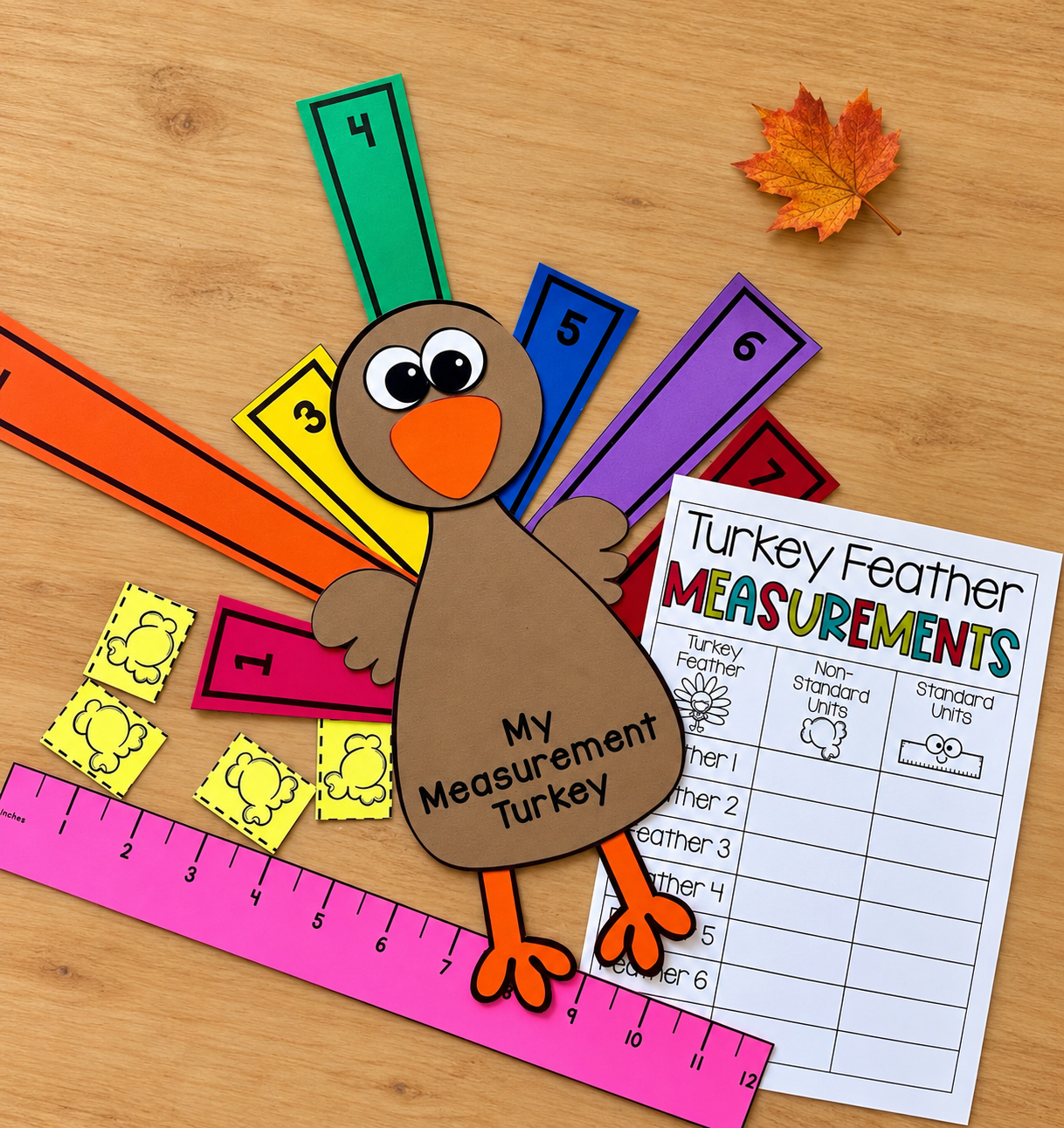
Set up a small measuring tray
Gather paper strips of several lengths, equal-sized linking cubes or paper measuring cards, pencils, and a place to record results. Add scissors, glue, and turkey pieces for the assembly stage. For standard measurement, provide a real classroom ruler.
If you use the printable popcorn, cut the cards to equal dimensions and keep them facing the same direction. Measure with the edges of the cards, not the uneven outline of the popcorn illustration. Real popcorn pieces vary in size, so they are not a good first choice for practicing equal measurement units.
Set out only the materials children need for measuring. Save the glue for later!
Model one feather from start to finish
Choose a strip and ask children to predict how many cubes or cards will cover its length. Accept a reasonable guess, then demonstrate how to check it.
- Lay the strip flat and point to the two ends you will measure between.
- Begin the first unit at one end of the strip.
- Place equal units in a straight line along its length, with no gaps or overlaps.
- Count each unit once and say the unit name with the number.
- Record the result before moving the strip.
If the final unit extends past the end, talk about what children see. They might describe the length as a little more than three cubes or between three and four cubes. Do not force an exact whole-number answer when the materials do not produce one.
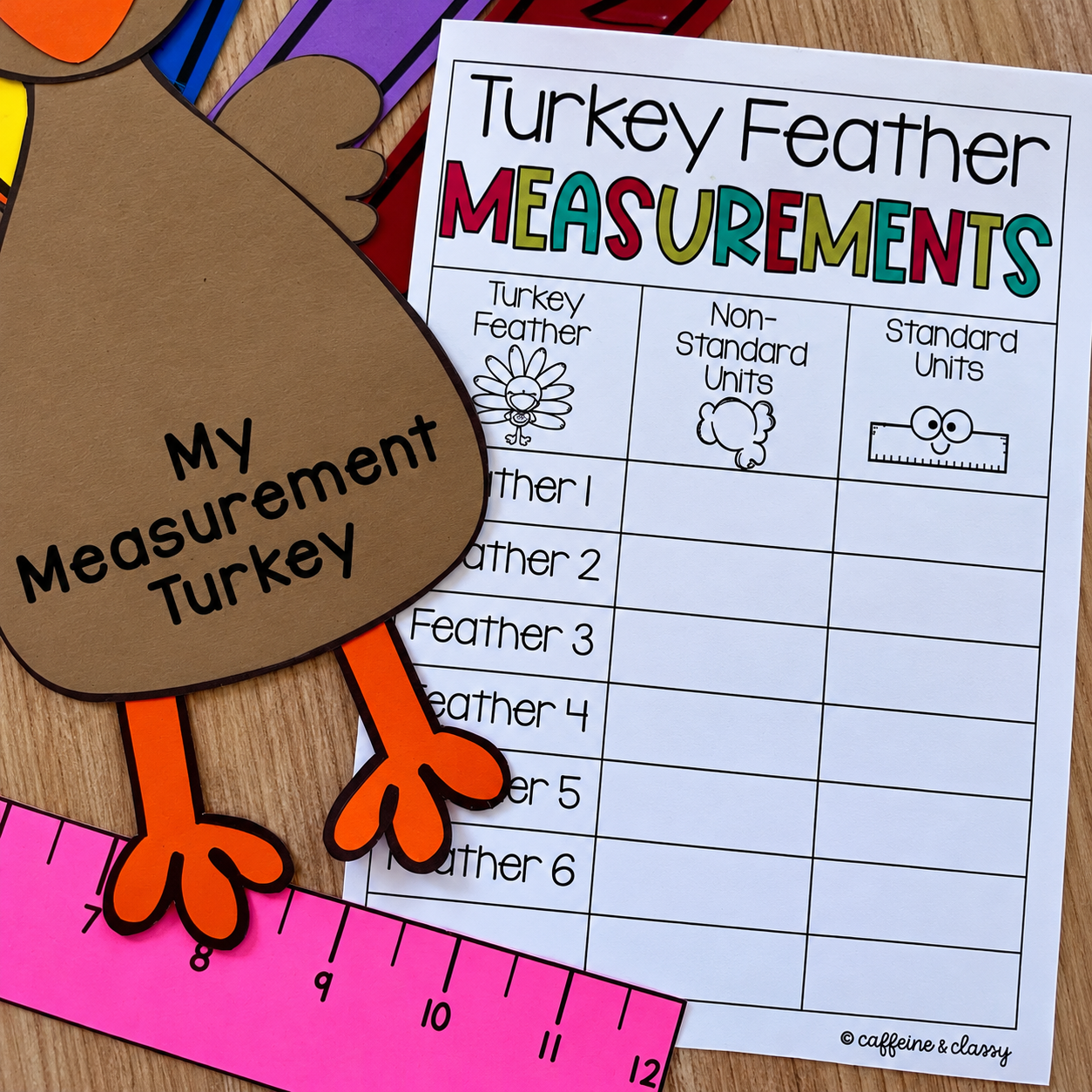
With the numbered printable feathers, explain that the number tells you which feather to record. Feather 5 is not automatically five inches long! Have children find the matching row before they write.
Let partners check the process
Start with two or three loose feathers rather than a full set. One partner places the units while the other checks the starting point, spacing, and count. Then switch jobs.
Before reaching for more units, ask children to line up two feathers at the same end. Which looks longer? Can they show how they know? This gives them a comparison to check against their measurements.
Use a quick check-in before assembly: ask each child to show one measured strip and explain the answer. A correct number is helpful, but watching how children place the units tells you more about what they understand.
Adjust the task without changing the goal
For preschool and beginning learners: Offer two clearly different lengths, larger units, and adult support. Children can point to the longer strip, count aloud, or dictate a result. Measuring every feather and completing both recording columns is not necessary.
For children ready to record: Use several feathers and one consistent unit. Encourage a spoken sentence such as, “This feather is about four cubes long.” Provide help writing the number without taking over the measuring.
For children ready for standard units: Model starting at the ruler's zero mark, not necessarily its physical edge. Choose inches or centimeters, name the unit, and keep the same endpoints. Discuss between-mark results at a level your group can handle.
For an extra challenge: Measure the same strip with two different sizes of equal units. Ask why smaller units need a larger count. The strip has not changed; the measuring unit has.
Add an optional preschool counting song
For a younger group, “Ten Little Turkeys” by The Learning Station offers a turkey-themed musical break. Preview the official song before using it.
After listening, count a small group of cubes together, touching each cube once. Then put those cubes beside a paper strip to practice measuring. Explain that counting tells how many objects are in the group; measuring also requires arranging equal units carefully along a length. This follow-up is a separate teaching idea, not an included song activity.
Questions worth asking before the glue comes out
- What happens if we leave a gap between two cubes?
- How can we make sure both partners start in the same place?
- Could two people get different numbers if their units are different sizes?
- Which feather is longest? What evidence supports your answer?
Once the measurements are checked, assemble the turkeys and keep the recording sheets with them. Invite children to share one comparison instead of simply showing the finished craft.
If you would like the printable pieces, my Measurement Turkey Math Craft includes turkey templates, seven numbered feather designs, printable popcorn, a printable ruler, and a recording sheet with standard and nonstandard columns. Pair it with equal-sized units and a real ruler, and make the measuring the part children can explain.