
A Christmas Tree Cake Investigation for K–2: Five Senses, Math, and Writing
The first thing my students want to do with a Christmas tree cake is take a bite. And honestly? Same. But before anyone tastes it, try asking, “What can you find out about this cake without taking a bite?” Suddenly they’re noticing tiny details they would have gobbled up without a second thought. That’s the start of a little December science lesson that gives kids something they’re genuinely excited to write about.
Start with a five-minute observation
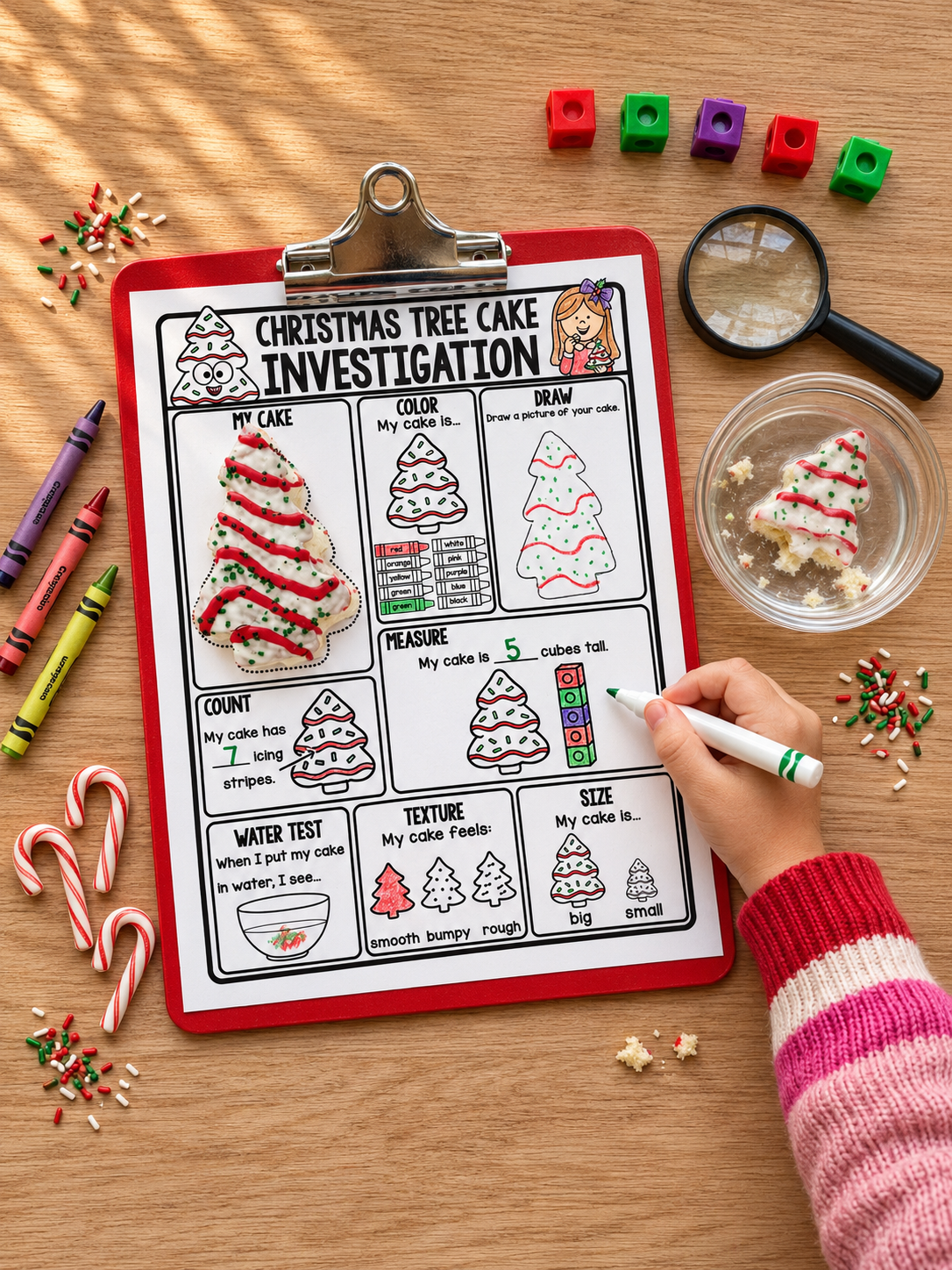
You only need a tree-shaped snack cake, a plate, and paper to get started. Put the cake where everyone can see it and give students a quiet moment to look before they share. Ask them to sketch what they actually see, then tell a partner one detail they almost missed. Can they describe the icing without saying “good” or “yummy”? Where are the sprinkles? What clues tell them how the outside might feel? A magnifying glass is fun if you have one, but it’s not necessary.
Measure, count, and compare
Give pairs a few same-size linking cubes and show them how to line the cubes up from the tip of the tree to the bottom of the trunk, without gaps or overlaps. Count the cubes together, then measure across the widest part. If an edge lands between two cubes, say “about” instead of pretending the measurement is exact. Ask: “Which measurement is longer? How do you know?” Then have students try it with a different-size unit and talk about why their number changed even though the cake didn’t.
Make a prediction and look for evidence
Set aside one piece from the cake as a dry comparison. Put a similar-size piece in a small clear bowl of water and ask students what they think will happen first. After a few minutes, look again. Ask, “What changed color or texture?” “What stayed the same?” and “What did you see that made you change your mind?” Have them draw or tell what changed instead of requiring a particular result. The cake can soften or break apart, but that doesn’t mean every part dissolved.
Turn one detail into a sentence
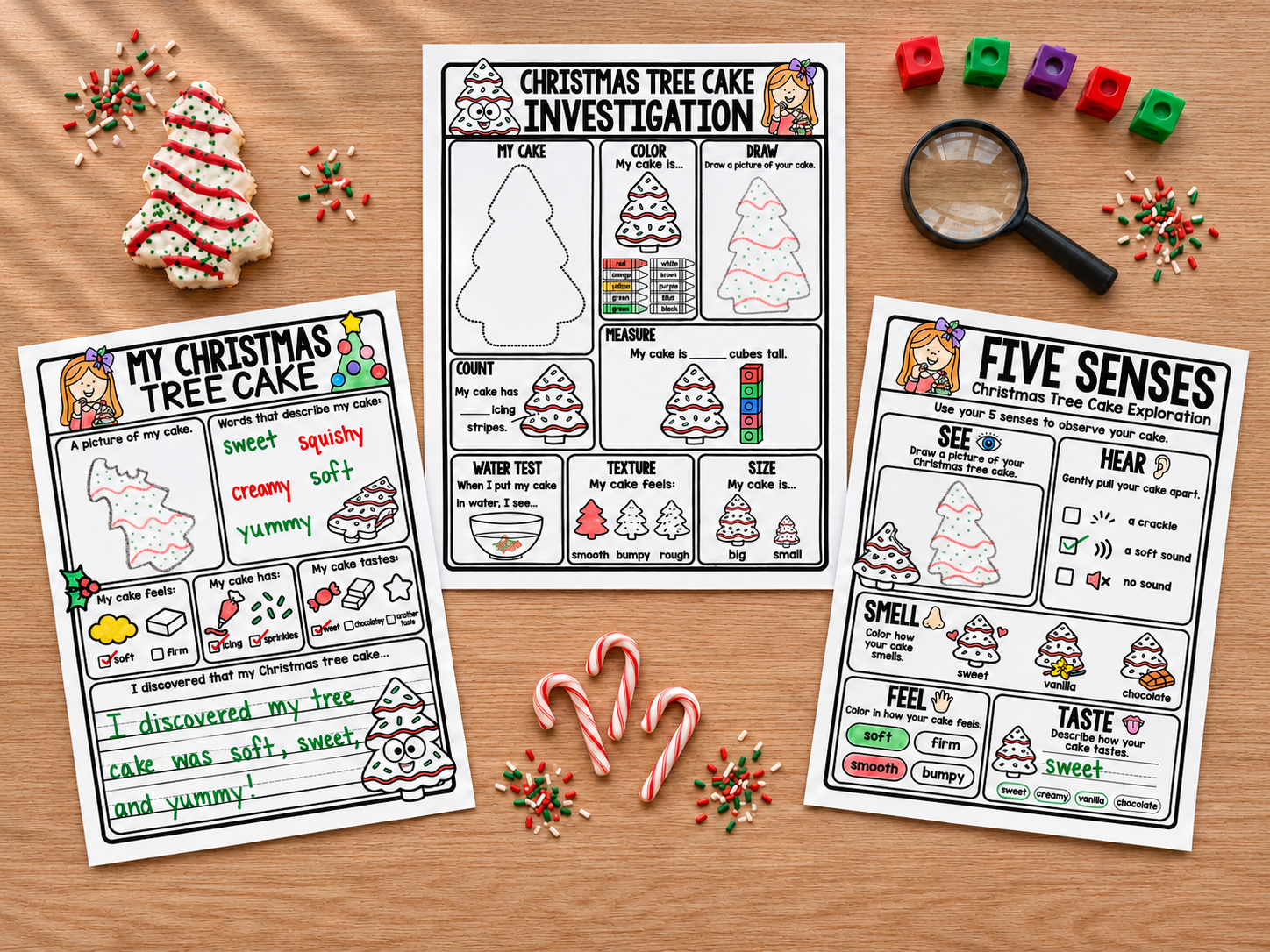
Give children a reason to use more precise words: “My cake looks ___, and I noticed ___.” Emerging writers can draw, label, or dictate one observation. More independent writers can compare the wet and dry samples in two sentences and point to their evidence. When food isn’t permitted or a student can’t taste it, keep the same discussion with a teacher-led demonstration or photos. Follow school food and allergy rules; tasting is optional, and investigation samples are not for eating.
Want the recording pages ready to print?
My Christmas Tree Cake Investigation brings the observation, measuring, five-senses work, and writing together. It includes K–1 and 1–2 writing-line options so you can run the same activity and give students the page that fits. I’d start with the one-question observation even if you only have a few minutes. The things kids notice before that first bite are half the fun.